Your bag (0)
Your bag is currently empty.
Our essentials



Drawer menu
Fill weight, filling, size: the three criteria for choosing a duvet, in the right order — and why it is your bedroom temperature that decides, not the calendar.

A duvet is chosen on three criteria, in this order: fill weight, filling, size. The first depends on the temperature of your bedroom much more than on the season. The other two are settled in a minute once the first is decided.
Fill weight is expressed in grams per square metre. It measures the amount of filling, and therefore the insulating power. A bedroom at 16 °C and a bedroom at 21 °C do not call for the same duvet, whatever the season.
| Fill weight | Bedroom | Use |
| 200 to 250 g/m² | above 20 °C | Summer, sleepers who run hot |
| 300 to 350 g/m² | 19 to 20 °C | Spring and autumn, well-heated flat |
| 400 to 450 g/m² | 16 to 18 °C | Winter, the most common range |
| 500 g/m² and above | below 16 °C | Unheated bedroom, old house |
The benchmark to remember: a bedroom at 16-18 °C is generally considered the most conducive to sleep, and that is the temperature most sleepers fall around. If you wake up clammy, the problem is more often the fill weight than the fabric of the cover.
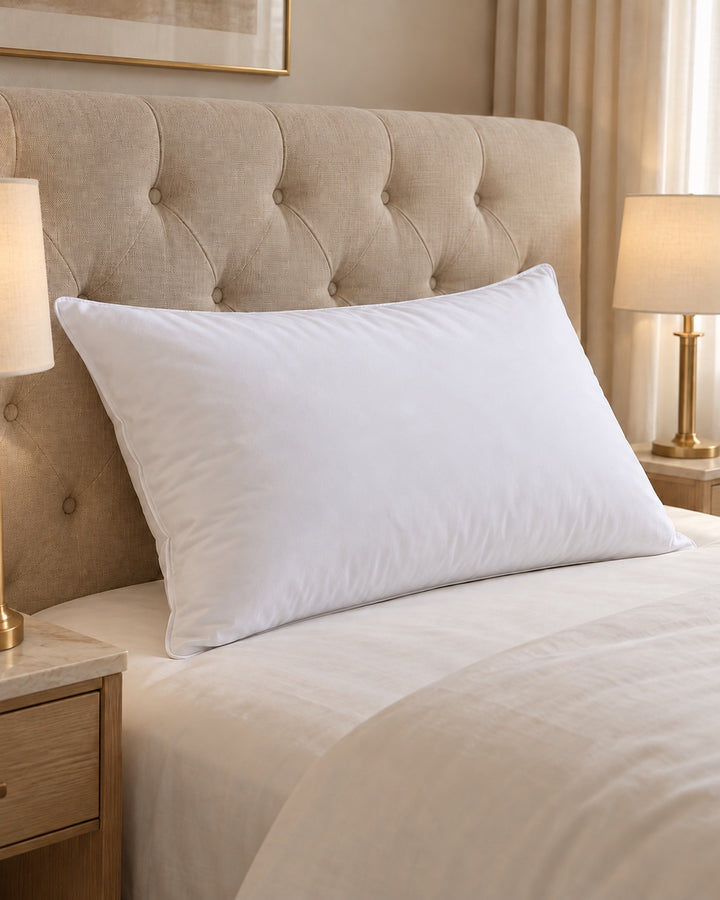
Natural filling — goose or duck down and feathers — has the best warmth-to-weight ratio. It envelops without weighing you down, lets moisture through and lasts a long time. It is what you find in Noctua pillows, filled with goose feathers and down. It requires more technical care, and it does not suit everyone.
Synthetic filling in microfibre or hollow fibres is easier on the budget, easier to machine wash, and is often recommended for people sensitive to dust mites. It generally keeps its loft for less time than good down.
Neither is better in absolute terms. Natural wins on comfort and longevity, synthetic on care and price.
A single 400 g/m² duvet covers the whole year in a normally heated home. It is the default choice, and the simplest.
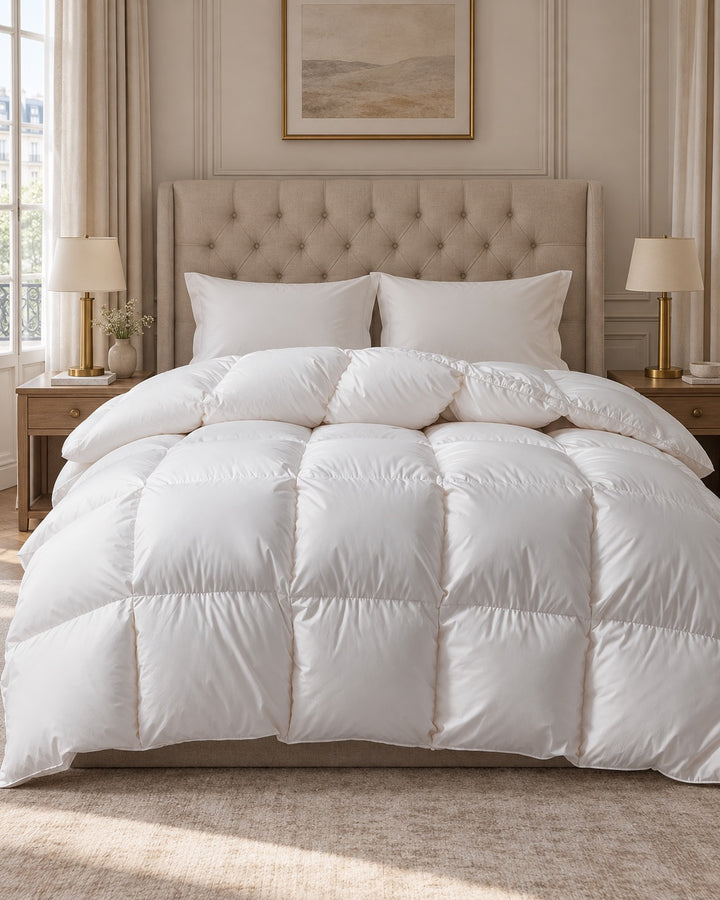
The duvet designed not to overheat. The Hôtel 4 Seasons duvet aims for the loft of a hotel duvet without the weight: a lofty microfibre filling, a 100% cotton shell, and dark piping all the way round that stops the edges fraying over the washes. It keeps you warm without overheating, which makes it comfortable almost all year round. It comes in 200x200, 220x240 and 240x260.
The signature piece. The Noctua Édition duvet combines a premium filling with a very soft shell, thermoregulating and comfortable in every season. It comes in sizes from 150x200 to 240x260.
Two separate duvets on the same bed, Scandinavian-style. Each person has their own fill weight. It is the most effective solution when one person is hot and the other cold, and the subject is developed in our article on sleeping cooler at night. All our models are gathered in duvets.
A duvet should be 30 to 40 cm wider than the mattress on each side. This overhang is not decorative: it is what keeps you covered when you turn over.
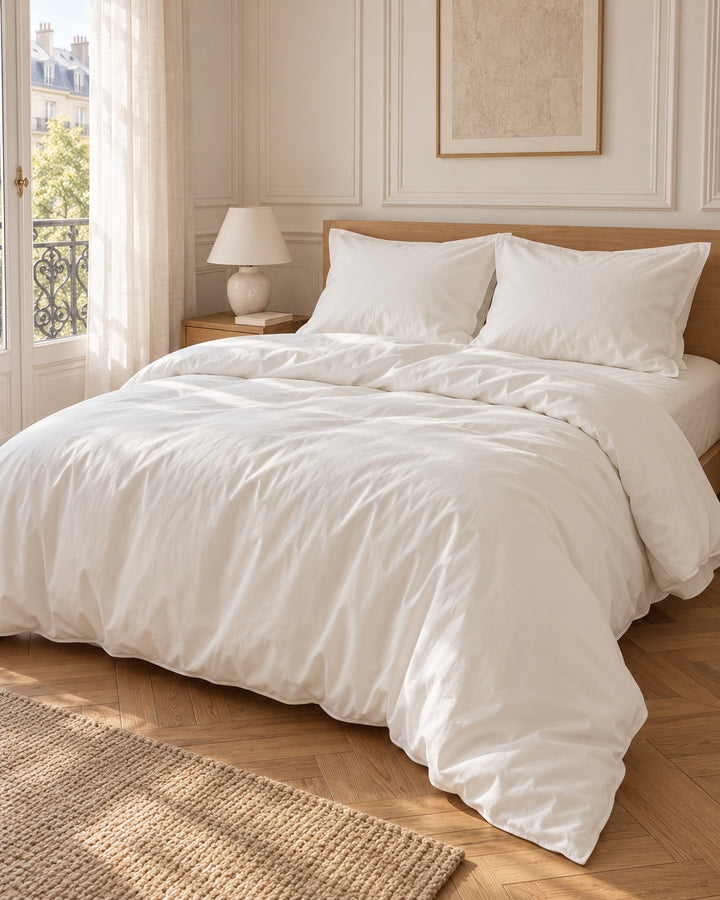
The cover takes exactly the same dimensions as the duvet. It is the basic rule of the bed linen size guide, and it works the other way round too: if you already have a 240x260 cover, the duvet must be 240x260. Available sizes are listed in duvet covers.
A duvet is washed once or twice a year, no more, provided it is protected by a cover that is changed regularly. Between washes, shake it for a few seconds every morning: this redistributes the filling and keeps the loft.
Always follow the label, in a drum large enough for the duvet to move, and dry it completely — a duvet that stays damp inside goes mouldy. Down does not cope well with frequent washing: prefer airing it at the window on a dry day. Other care habits are gathered in how to wash and care for your bed linen.
Measure your bedroom on a winter evening before ordering. The thermometer will tell you the fill weight more reliably than the calendar.
Le journal


