Your bag (0)
Your bag is currently empty.
Our essentials



Drawer menu
How often, at what temperature, how to dry? The Noctua guide to keeping bed linen soft and beautiful, wash after wash.
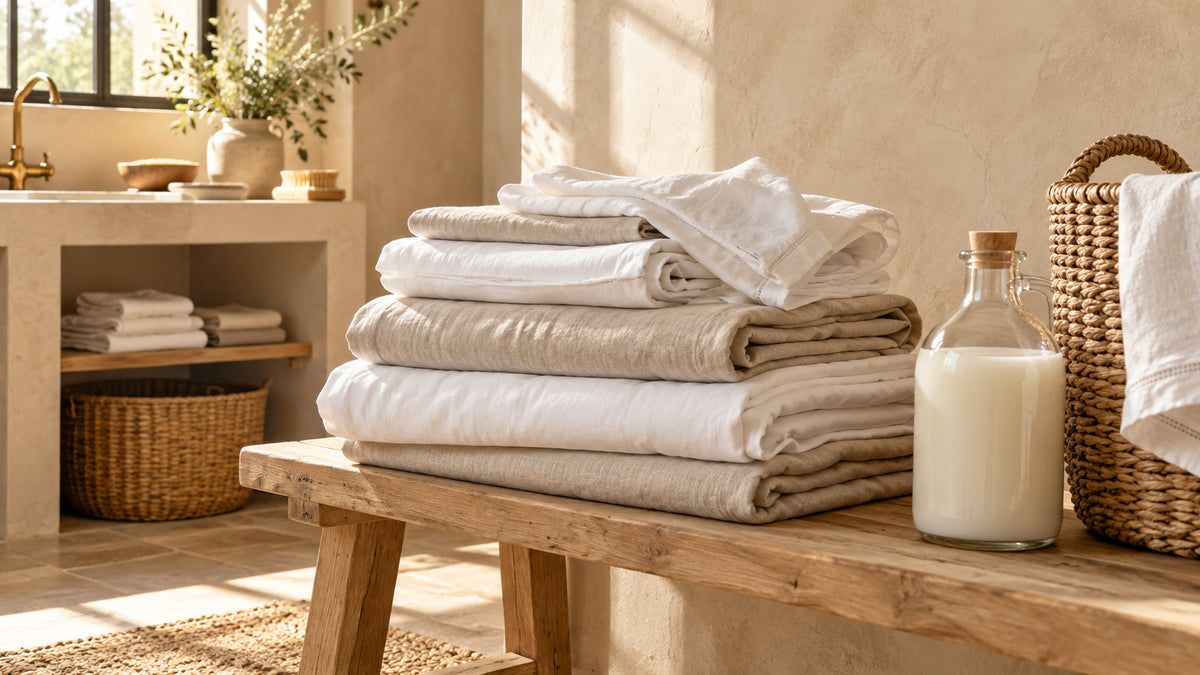
You make a bed without thinking about it. Then one day the fitted sheet no longer stretches over the mattress, the white cover has turned beige, and the gauze you loved for its softness has started to feel scratchy. Almost all these mishaps come down to three settings: temperature, spin and detergent. This guide covers the subject from start to finish — how to wash your sheets according to the fabric, how often, with what, and what to do when the stain is already there.
Once a week for the duvet cover, fitted sheet and pillowcases. This is the widely agreed recommendation, and it rests on a simple calculation: an eight-hour night means around 30 cl of sweat, tens of thousands of dead skin cells and a little sebum left in the fabric. After seven nights, the fitted sheet has absorbed the equivalent of two litres of moisture.
Two common adjustments. In summer, or if you sweat a lot, switch to twice a week at least for the pillowcase — it is the one that receives your face, hair and night-time skincare. Conversely, in winter, with pyjamas and a cool bedroom, ten days remain acceptable for the duvet cover.
Duvets and pillows follow a different rhythm: two to three washes a year are enough, provided you use a quilted waterproof mattress protector and pillowcases that you change every week. We go through the variations — pets, allergies, seasons — in our article on how often to change your sheets.
This is the table to remember. Each fabric has its limit, and exceeding it just once is sometimes enough to shrink a piece permanently.
| Fabric | Temperature | Spin | Drying | Ironing |
|---|---|---|---|---|
| 400 thread count Egyptian cotton | 40 °C, cotton cycle | 800 to 1,000 rpm | Air, or tumble dry warm | Yes, inside out, with steam |
| Soft cotton | 40 °C (60 °C occasionally) | 1,000 rpm | Air or tumble dry warm | Optional |
| Washed cotton percale | 30 to 40 °C | 800 rpm | Air, in the shade | Yes, slightly damp |
| Cotton gauze | 30 °C, delicate cycle | 600 to 800 rpm | Air, take out damp and shake | No |
| Eucalyptus lyocell | 30 °C, delicate cycle | 600 rpm | Air only | Rarely, cool iron on the reverse |
| 22 momme mulberry silk | 30 °C by hand or delicate | 400 rpm maximum, or none | Flat, in the shade | Cold iron, reverse, no steam |
| Satin | 30 °C, delicate cycle, laundry bag | 400 rpm maximum | Flat, in the shade | Cold iron, reverse |
| Washed linen | 30 °C | 600 to 800 rpm | Air, no pegs | No, the creases are its signature |
A quick reading: the finer, nobler or more naturally creased the fibre, the lower you go in temperature and spin. 60 °C is only justified on white cotton, occasionally, after an illness or an accident. It is not a routine. You will find these limits, summarised by range, on our care advice page.
A gentle liquid detergent, without optical brighteners or bleaching agents. Powders rinse poorly from dense weaves and leave whitish streaks on dark colours. Use half a cap: overdosing is the leading cause of sheets turning rough, because the residue builds up in the fibre and stiffens it wash after wash.
Fabric softener poses a different problem. It works by depositing a greasy film on the fibre. On cotton, this film blocks moisture absorption — you lose precisely the property for which you chose a breathable cotton. On lyocell, it cancels the thermoregulating effect. On linen or cotton gauze, it prevents the natural softening that should come with washing. Half a glass of white vinegar in the softener compartment does the job better: it dissolves limescale, genuinely softens, and the smell disappears completely once dry.
Silk deserves a paragraph of its own. Silk is a protein fibre, like wool and like hair. Modern detergents contain enzymes — proteases, lipases — whose role is precisely to dissolve the proteins in stains. An enzyme detergent cannot tell the difference between a stain and your pillowcase: it attacks the fibre itself, which loses its lustre within a few washes and eventually dulls. Use a special silk detergent or, failing that, a mild pH-neutral shampoo. The full method for washing silk is explained in a dedicated article, and the pieces concerned are gathered in the silk and satin collection.
Three products to remove from the laundry room: fabric softener (greasy film, loss of absorbency), bleach (it attacks cotton cellulose and destroys silk), and "whitening" detergents with optical brighteners, which do not whiten the fabric but deposit a bluish pigment on the surface. This pigment builds up, turns grey, and is then very hard to fix.
Always wash a bedding set before the first night. It is not just a question of hygiene: the first machine wash removes excess dye and the factory finish, the treatment that gives new fabric its slightly papery feel in the shop.
Three rules for this first wash. On its own, or with pieces of the same colour — intense dyes such as indigo, terracotta and deep green almost always bleed on the first wash. At 30 °C, even if the fabric can take more, to limit initial shrinkage. And with half a glass of white vinegar, which helps fix the colour.
Expect 2 to 3% shrinkage on cottons and up to 5% on gauze. This is normal and expected: serious manufacturers cut generously to allow for it. Shrinkage happens almost entirely at the first wash, then stabilises. This is also why it is better to buy a bedding set in the right size from the outset rather than hoping it will shrink.
On washed fabrics — washed cotton percale, washed linen — the first wash also changes the feel. The fabric comes out softer than it went in. That is the very principle of these finishes.
Two-thirds of the drum, no more. You should be able to slide a hand between the linen and the drum wall with the door closed.
An overloaded machine washes badly, rinses even worse, and leaves concertina creases that nothing will fix afterwards. In practice, in a 7 kg machine: a 240x260 duvet cover alone already fills almost the whole drum. A 200x200 cover fits with its two pillowcases. Wash the fitted sheet separately if you want it to come out really clean.
Two habits that prevent nasty surprises. Close the buttons or fastening of the duvet cover before washing, otherwise it swallows the pillowcases and spins them into a ball. And turn the pillowcases inside out: the side that touches your skin gets cleaner when exposed to the water's friction.
Take the linen out of the drum as soon as the cycle ends. Ten minutes of damp cotton packed into a closed machine and you inherit set-in creases that will stay. It is the most worthwhile habit in all of bed linen care.
Shake each piece out widely with both hands, holding it by two opposite corners. This movement reopens the weave compacted by the spin and removes half the creases before you even hang it up. On fabrics with a deliberate crumple, this is where everything happens: we explain how to get a beautiful crumple on cotton gauze rather than just putting up with it.
Air drying remains best for all fabrics. Preferably in the shade: direct sun whitens white but fades colours. Hang duvet covers over two lines if you have them, or folded in half inside out, to avoid a peg mark right in the middle.
The tumble dryer is not forbidden for cotton, provided you stay on a warm programme and take the linen out while still slightly damp to finish in the air. At full heat, the drum breaks surface fibres and causes pilling — this is what gives poor-quality sheets their fuzzy look after six months. For silk, gauze and lyocell, no tumble dryer at all.
It depends entirely on the fabric, and the honest answer is: much less often than you think. Percale and Egyptian cotton sateen look crisper after ironing. Gauze and linen, on the other hand, lose their character: their crumple is what makes them lively, and ironing flattens them into a fabric without texture.
When you iron, do it inside out, on fabric that is still slightly damp, with steam. A hot iron on a dry fibre creates a surface shine that will not go away. We explain fabric by fabric what is worth ironing and what is not, with the drying method that lets you skip it almost every time.
Three principles apply to all stains. Act fast, because a dry stain is twice as hard to remove. Dab, never rub, because rubbing pushes the stain into the weave and causes pilling. And always cold water first: hot water cooks proteins and permanently sets blood, milk or sweat.
Three common cases, to fix the right moves:
| Stain | Immediate reflex | Treatment |
|---|---|---|
| Blood | Cold water immediately, never hot | Marseille soap, dabbing, then 3% hydrogen peroxide on white only |
| Make-up, foundation | Dab dry, do not spread | Stain-removing soap applied dry for 10 minutes, then a normal wash |
| Red wine | Absorb with kitchen paper, without rubbing | Sparkling water, then sodium percarbonate. Salt sets the stain on cotton, avoid it |
A rule that costs dearly when ignored: never put a piece in the tumble dryer if the stain has not come out. Heat sets it for good. Check when you take it out of the machine, retreat if necessary, then dry. Stains specific to sleep — sweat, sebum, yellow marks, coffee spilled at breakfast — and white that has turned beige or grey without a specific stain call for another method. We cover them product by product, from percarbonate to white vinegar, in yellowed sheets, stains and greyness.
Linen must be completely dry before it goes into the cupboard. A piece stored slightly damp develops mould spots within a few weeks, and the smell no longer comes out in the wash.
Fold a fitted sheet by tucking the four corners into each other, elastic inwards, then folding the resulting rectangle into three. Once you have the knack, it takes thirty seconds.
The most practical storage tip: slip the duvet cover, fitted sheet and second pillowcase inside the first pillowcase. You get a neat bundle, one complete set per pouch, and you never again have to search for the matching piece at the back of the shelf.
Store on an open shelf or in a cotton bag, never in a plastic cover — textiles need to breathe. A lavender sachet or a piece of cedar is enough to keep moths away, without chemicals that impregnate the fabric for months.
It all comes down to a few things: 30 to 40 °C, a moderate spin, half a dose of gentle detergent, air drying, and linen taken out of the drum as soon as the cycle ends. Five habits, applied every week, add years to a bedding set. If you are still unsure which fabric would suit you best, our fabric guide covers the subject from the beginning.
The best care investment, though, is rotation. With two sets, each piece rests between uses, the fibres relax, and the whole set lasts much longer. It also means you can remake the bed on washing day. Our pieces can be ordered separately across the whole Noctua bed linen range, so you can put together a second set without starting from scratch.
Le journal


