Your bag (0)
Your bag is currently empty.
Our essentials



Drawer menu
Where eucalyptus lyocell comes from, why it stays cool, how it feels and how to care for it: the fabric to choose when you sleep hot.

There are sleepers who pull the duvet up and those who stick a foot out. If you belong to the second group, eucalyptus lyocell is the fabric we would recommend before any other. Here is where it comes from, why it stays cool, and what it is like day to day.
Lyocell is neither a raw natural fibre like cotton nor a synthetic fibre like polyester. It is called a man-made fibre of plant origin: the raw material is wood, processed so that it can be spun.
In our case, it is eucalyptus pulp. The tree grows fast, on soils unsuitable for food crops, and needs much less water than the cotton plant. The wood is reduced to chips, then to cellulose pulp.
The pulp is dissolved in an organic solvent until it forms a thick paste. This paste is then pushed through spinnerets pierced with tiny holes, which turn it into continuous filaments. The filaments are washed, dried and then spun.
The special feature of the process lies in the solvent: it is recovered at the end of the cycle and fed back into production instead of being discharged. This is called a closed loop, with recovery rates exceeding 99% in modern plants. This is what distinguishes lyocell from conventional viscose.
The resulting fibre has an internal structure that can absorb moisture and carry it to the outside of the fabric, where it evaporates. In practice: sweat does not linger against the skin.
This is the major difference from cotton. Cotton absorbs well, but it holds on to moisture — hence the feeling of a damp sheet in the middle of the night. Lyocell moves it along, which keeps the contact temperature more stable in both directions: cool when you are hot, never icy when the room cools down.
Add to that a very smooth fibre surface: it glides over the skin instead of catching, with less friction than a fabric with a pronounced texture.
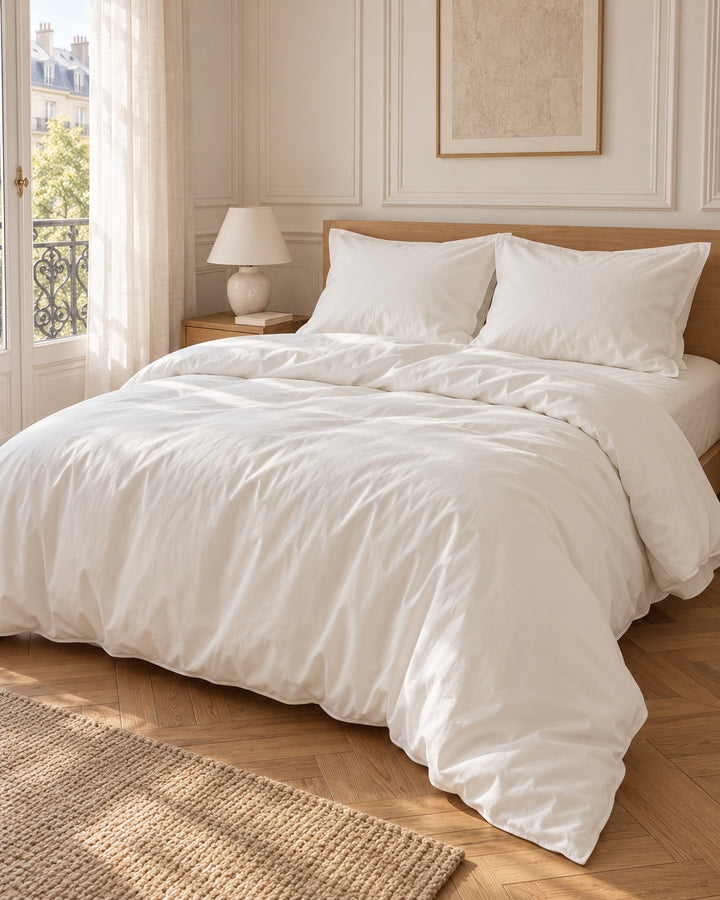
Visually, lyocell is the closest thing to silk in a bedroom. The fabric has a soft sheen, falls in long, fluid folds, and follows the shape of the bed instead of staying taut. To the touch, it is cool and smooth — the feeling you look for when getting into bed on a July evening.
Our eucalyptus lyocell duvet cover comes in seven colours and five sizes, from 140x200 for a single bed to 260x240 for a 180 cm bed. It is featured in the eucalyptus lyocell collection.
Lyocell is for you if you wake up clammy, if your bedroom faces south, if your skin dislikes rough fabrics, or if you sleep with someone whose internal thermostat is nothing like yours.
It is less so if you really feel the cold and want the enveloping feel of a thick sateen, or if you love the pronounced crumple of linen and gauze — lyocell stays smooth.
If you want coolness but prefer a matt, crisp feel rather than a satiny one, washed cotton percale is the other good answer. We compare the two approaches in our article on how to sleep cooler at night.
Wash at 30 °C on a delicate cycle, with the machine three-quarters full so the fabric has room to move. No fabric softener: it leaves a film on the fibre and makes it lose exactly the property you chose it for. No bleach either.
Air dry in the shade, shaking the piece out before hanging it: lyocell loses most of its creases as it dries. If you insist on ironing, use a warm iron on the reverse. Treated well, this fabric keeps its drape over time.
To see how lyocell compares with Egyptian cotton, percale, gauze and silk, our bed linen fabric guide sets them all side by side. Start with a single piece if you are unsure — it is the most honest way to test a fabric.
Le journal


