Your bag (0)
Your bag is currently empty.
Our essentials



Drawer menu
Washed linen has been the most sought-after bed linen fabric for five years, and the one surrounded by the most half-truths. This guide tells you both sides: what linen does very well, and what it asks in return — feel,...

Washed linen has been the most sought-after bed linen fabric for five years. It is also the one surrounded by the most half-truths: the crumpled look is sold as a lifestyle without saying you have to embrace it, and a softness is promised that only really arrives by the tenth wash. This guide tells you both sides — what linen does very well, and what it asks in return.
Linen is a plant fibre taken from the stem of the flax plant, grown along a coastal strip running from Normandy to the Netherlands via Belgium. This area produces around 80% of the world's textile flax. Oceanic climate, regular rain, no irrigation: the plant grows in a hundred days and needs almost nothing.
After harvesting, the stem goes through retting — it is left lying in the field, where dew and micro-organisms loosen the fibre from the wood — then scutching, hackling and spinning. The resulting yarn is stiff. Woven as it is, it gives the linen of our grandmothers' linen cupboards: sturdy, a little papery, and needing ten years of use before becoming pleasant.
Washed linen is that same fabric put through an intensive mechanical wash after weaving: water, a drum, sometimes stones or enzymes. The treatment breaks down the stiffness of the fibres and does in one step what bedding used to take a decade to do. Nothing is added to the fabric; it simply loses its original stiffness.
Two terms not to confuse. "Washed linen" refers to this softening treatment. "Faded linen" only refers to the colour, obtained by bleaching. Faded linen can remain perfectly stiff. If the label only says "faded", ask the question.
Washed linen is not soft like brushed cotton. It is crisp. You can feel the material, there is a slight resistance under the palm, a texture. People who love linen love exactly that: the sheet does not stick to the skin, it does not slide, it stays in place when you move.
And the first nights are rougher than the photos suggest. This is true everywhere, whatever the price paid. Here is the usual curve of washed linen over the washes.
| Stage | What you feel |
| Out of the packet | Crisp, a little stiff, almost papery along the fold lines. Slight plant scent. |
| Washes 1 to 3 | The fabric relaxes, the creases soften, the drape becomes heavier. The first real change. |
| Washes 5 to 10 | Clear softening. This is the linen in the photos, the one you were sold. |
| Washes 20 to 30 | Plateau. The fabric no longer gains much softness — but it will never stiffen again. |
| After a few years | Maximum softness, fluid drape, slightly patinated colour. This is when linen is at its most beautiful. |
If this break-in period makes you hesitate, we have devoted a whole article to the roughness of the first nights, with the curve and solutions.
This is the property that alone justifies the price. Linen absorbs up to 20% of its own weight in moisture before it feels damp, and releases that moisture very quickly into the surrounding air. In practice: when you sweat at night, the sheet takes up the moisture, moves it to the outside of the fabric and dries. You do not wake up sticky.
In winter, it is the structure of the fibre that does the work. The linen fibre is hollow. This trapped volume of air insulates, exactly as down does in a duvet. Add a weave that is less tight than percale, and you get a fabric that lets air circulate without letting body heat escape.
The result is a bedding set you keep all year round, changing only the duvet underneath: this is exactly what the washed linen bedding set does, cover and pillowcases included. The mechanism is explained in detail, with figures and comparisons, in our article on linen in summer and winter. If you want the same thermal benefit with a smoother feel, eucalyptus lyocell plays the same role with a satiny drape.
When dry, linen fibre is two to three times stronger than cotton fibre. When wet, it becomes even stronger — the opposite of most fibres. That is why a linen sheet can withstand hundreds of washes without wearing through.
A good-quality washed linen bedding set, washed correctly, lasts ten to twenty years. And it does not deteriorate in a straight line: it improves over the first five years, then stabilises. It is one of the rare textiles that can truly be said to get better with age.
Spread over its lifespan, this changes how you read the price: a set kept for fifteen years costs less, year after year, than an entry-level set replaced every two or three years. Up-to-date prices, size by size, are shown on each product page.
| Scenario | Lifespan |
| Entry-level cotton set, replaced | 2 to 3 years |
| Washed cotton percale set | 8 to 12 years |
| Noctua washed linen set | 10 to 20 years |
If the budget for a complete set comes too soon, you can start with the most visible piece: the washed linen duvet cover on its own, or a pair of washed linen pillowcases to test the fabric against your cheek before committing.
Linen creases because its cellulose fibre has almost no elasticity. It does not spring back into shape on its own, unlike wool or synthetic fibres. No treatment removes this behaviour without stiffening the fabric — "non-iron" linens are coated, and in the process they lose the breathability that makes the fabric worthwhile.
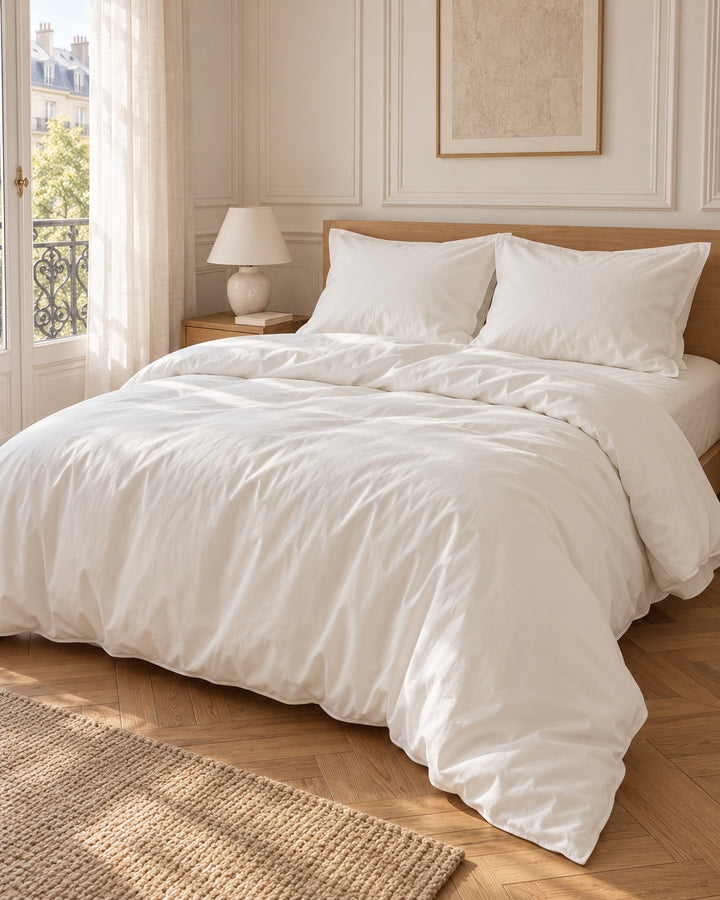
So yes, a linen bed has creases. That is the aesthetic of the fabric, and it is also what gives bed linen a lived-in look rather than a showroom look. Three steps are enough to get a neat crumple rather than a tired one: take the set out of the drum while still damp, shake it out widely with both hands, and hang it without pegs. The weight of the water does the iron's job.
If creases really bother you, do not choose linen. Cotton gauze offers the same relaxed drape in a lighter fabric, and washed cotton percale gives a matt, neat finish that is much smoother.
Three criteria determine quality, and none of them is price.
Fabric weight, expressed in grams per square metre, tells you the density of the fabric. It is the most useful information on a linen product page, and often the one that is missing.
| Weight | Drape | Who it suits |
| 105 to 125 g/m² | Light, fluid, almost see-through in the light | Warm bedrooms, summer use. Wears faster. |
| 140 to 165 g/m² | The bedding standard. Balance between body and softness. | Most beds, all year round. |
| 170 to 190 g/m² | Dense, heavy, sculptural drape | Cool bedrooms, lovers of a substantial fabric. Takes longer to soften. |
Origin. Linen grown and spun in Western Europe has longer, more even fibres, and therefore a stronger yarn that is less prone to fluff. Look for the country where it was grown, not just where it was made: the two are often different.
Finishes. They determine lifespan more surely than the fabric itself. Flat-felled seams rather than simple overlocking. Buttons rather than a zip, which is almost always the first part to fail — that is the reason for the natural wooden buttons on our washed cotton percale bedding set. And on a fitted sheet, a deep pocket with elastic all the way round, not just at the corners.
Our linen range is gathered in our washed linen collection, where the washed linen bedding set also fastens with wooden buttons, in 140 x 200, 200 x 200, 240 x 220 and 260 x 240, in five colours — natural, white, pearl grey, terracotta and slate grey.
Four fabrics, four sleeper profiles. The table below sums up what really separates them.
| Fabric | Feel | Temperature | Creasing | Who it suits |
| Washed linen | Crisp, lively, textured under the hand | The most regulating, summer and winter | Deliberate, structured | Those who want a single set for ten years |
| Washed cotton percale | Matt and crisp, cool when getting into bed | Cooling, less insulating in winter | Light, neat | The spirit of linen, with a smoother feel |
| Cotton gauze | Soft, airy, cosy | Very breathable, light | Naturally crumpled | Children's rooms, bohemian style, in-between seasons |
| Egyptian cotton | Silky, enveloping, smooth | Breathable, feels warmer | Little | Those looking for the comfort of a fine hotel |
To go further on the most common dilemma, the complete comparison between washed linen and cotton takes each criterion one by one. And our fabric guide presents the house's five fabrics, with the details of each on our fabrics page.
The detailed version — temperature, choice of detergent, spin, what really damages the fibre — is in our method for caring for washed linen, in our bed linen washing and care guide and on the care advice page.
The answer lies in the processing chain. A flax stem yields only about 20% usable textile fibre; the rest becomes shives, seeds and tow. Retting takes several weeks in the field and depends on the weather. Scutching and hackling are demanding mechanical steps. Spinning linen is more delicate than spinning cotton, and few mills in Europe are still able to do it.
Add the mechanical wash after weaving, which uses water and time and damages part of the production, and you get a structurally higher cost price. Linen at €60 a set does exist: it is short-fibre linen to which the word "washed" has been applied lightly. It will pill within a year.
Yes, if you accept creases, if you want a fabric that truly regulates temperature, and if you prefer to buy once for fifteen years. No, if you want instant softness out of the packet, a perfectly smooth bed, or an entry-level budget — in that case washed cotton percale or cotton gauze will make you happier.
Our washed linen collection is now in store: the complete set, the washed linen duvet cover, the fitted sheet and the washed linen pillowcase, in 50 x 70 and 65 x 65, to complete the bedroom piece by piece. And the whole Noctua bed linen range is gathered here, if you are still hesitating between two fabrics.
Le journal


