Your bag (0)
Your bag is currently empty.
Our essentials



Drawer menu
A matt, crisp feel on one side, a fluid, satiny drape on the other. We compare percale and cotton sateen on comfort, temperature, care and price.

Percale or sateen: it is the most common dilemma when choosing a cotton bedding set. Both are cotton, both are sold as premium, and yet you do not sleep the same way under them. The difference comes down to one thing: the way the threads cross.
Percale is a plain weave: one thread passes over, one thread passes under, regularly, at a high density. The resulting surface is flat and matt.
Cotton satin — its proper technical name is sateen — works differently: three or four threads pass over before one passes under. More thread is therefore exposed on the surface, over longer distances. This is what creates the smoothness and the sheen.
The same Egyptian cotton can produce either. The word "satin" says nothing about the material, only about the weave: cotton satin is still cotton, silk satin is silk. That is the first confusion to clear up.
You can recognise percale with your eyes closed. It feels crisp under the hand, slightly grainy, with that little sound of a fresh sheet when you pull it tight. Washed, it loses the stiffness it is sometimes criticised for and is soft from the very first night.
Sateen glides. The feel is silky, almost creamy, and the fabric follows the mattress instead of staying taut above it. It has a very subtle matt sheen in low light, where percale reflects nothing.
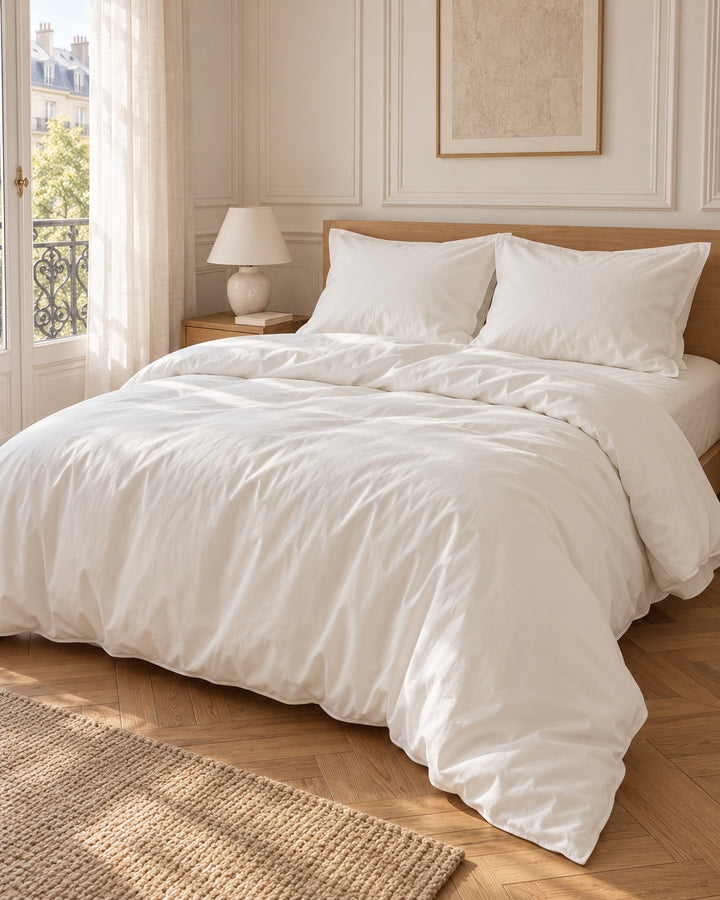
The visual result: percale creases and keeps a light, lively crumple, while sateen falls smooth. If your bed needs to look impeccable without any effort, sateen wins. If you love the crisp sheets of a hotel room, percale is made for that.
Percale, no question. Its airy structure lets air circulate, and its matt surface limits skin-to-fabric contact: it feels cool the moment you get into bed. It is the fabric to choose if you sleep hot or if your bedroom faces south.
Sateen is a little more enveloping. It is not stifling — it is cotton, it breathes — but it holds slightly more heat, which makes it comfortable in spring, autumn and winter, and for sleepers who tend to feel the cold.
If you sleep as a couple with opposite internal thermostats, percale remains the safest compromise: it is easier to add a blanket than to remove heat.
Both can be washed at 30 or 40 °C, without fabric softener, and age very well provided they were woven from a long-staple fibre.
One nuance matters: sateen exposes long lengths of thread on the surface. On mediocre cotton, these floats eventually snag and pill. On extra-long staple cotton, the problem does not arise — which is exactly why we only offer sateen in Egyptian cotton. And to know how to recognise this fibre beyond the label, we have explained what sets genuine Egyptian cotton apart.
On price, the two are on a par at equal quality. What really drives the bill up is not the weave but the fibre and the density — a subject we cover in our article on what thread count measures.
| Criterion | Washed cotton percale | Cotton sateen |
|---|---|---|
| Feel | Matt, crisp, slightly grainy | Silky, smooth, fluid |
| Look | No sheen, light deliberate creasing | Subtle sheen, smooth drape |
| Feeling when getting into bed | Cool | Warm, enveloping |
| Ideal season | Spring and summer, warm bedrooms | Autumn and winter, sleepers who feel the cold |
| Ironing | Optional, medium iron | Rarely needed |
| Watch out for | Creases | Needs a long fibre to avoid pilling |
Choose percale if you sleep hot, if you like a neat, taut bed, or if you are looking for a first good set of bed linen that gets through the summers. Our washed cotton percale bedding set comes in six colours, with natural wooden buttons rather than a zip, and the whole range is in the washed cotton percale collection.
Choose sateen if you want a silky feel, a fluid drape and gentle warmth. The Egyptian cotton sateen pillowcase is a good starting point: it is the piece in direct contact with your face, so it will tell you fastest whether the fabric suits you.
And if you are still hesitating between these two and gauze, lyocell or silk, our bed linen fabric guide compares them all. There is no rush: a bed is built piece by piece.
Le journal


