Your bag (0)
Your bag is currently empty.
Our essentials



Drawer menu
Once a week, and more often in summer: the right rhythm for changing your sheets, the pieces that follow a different schedule, and why two sets are better than one.

Once a week. That is the short answer, and it applies to the duvet cover, the fitted sheet and the pillowcases. The long answer is more interesting: depending on the season, how much you sweat, whether a pet sleeps in the bedroom or whether you are allergic to dust mites, this rhythm tightens or loosens by a few days.
An eight-hour night means around a quarter of a litre of sweat released, more in summer. Over a week, the fitted sheet and duvet cover have absorbed nearly two litres of moisture. Add dead skin cells — skin renews itself continuously, and the bed collects a good share — as well as sebum, cream residue and, on the pillowcase, night-time skincare and hair products.
This organic matter feeds dust mites, which thrive in a warm, humid environment. A weekly wash at 40 °C significantly reduces their numbers, without needing to go up to 60 °C — we detail the temperatures fabric by fabric in our bed linen care guide.
The linen itself benefits too. Fabric loaded with sebum yellows faster and loses its breathability, because the pores of the fibre become clogged. Washing regularly at a low temperature wears a sheet less than letting it get grimy and then treating it with lots of stain removers. When the white has already turned, there are ways to rescue yellowed sheets.
These pieces follow a completely different schedule, because they are protected by everything else. A duvet is washed two to three times a year, a goose feather and down pillow three to four times a year, at 30 °C with an extra rinse and very thorough drying.
The mattress protector is the forgotten piece. It absorbs what the fitted sheet lets through, and it is washed once a month. A quilted waterproof mattress protector saves you from having to treat the mattress itself, which cannot be washed. It is also what lets you space out duvet washes with peace of mind.
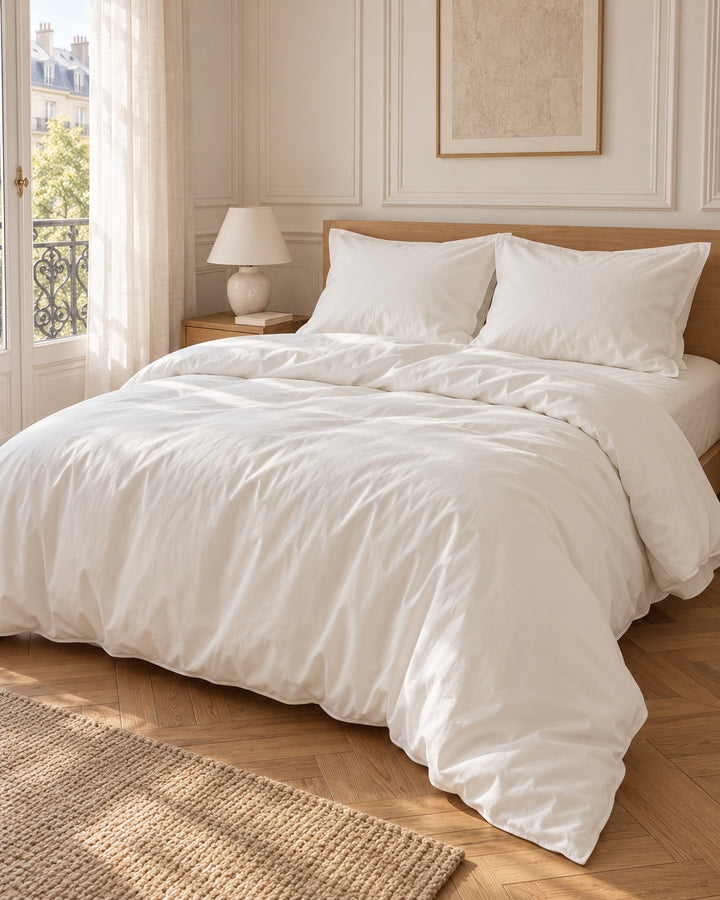
This is the only real comfort change on this subject. With a single set, changing your sheets becomes a logistical chore: you have to wash, dry and put it back on within the day, which is discouraging. With two bedding sets in rotation, it takes ten minutes and the dirty linen waits calmly for the next cycle.
There is a material benefit too. A fibre needs to relax between uses, and two sets in rotation share the nights and the washes instead of putting all the strain on one.
In practice, the most enjoyable rotation is to choose two different fabrics rather than the same one twice: a matt, crisp washed cotton percale for warm nights, a smoother, more enveloping Egyptian cotton for winter. You change bed without changing bedroom.
Airing the bed for ten minutes every morning, duvet folded back, does more against moisture than an extra wash. Making your bed immediately when you wake up, on the other hand, traps the night's sweat in the duvet.
And a sheet changed every week but washed with too much detergent ends up scratchy. Regularity does not make up for the wrong settings: half a dose of detergent, 30 to 40 °C, a moderate spin.
If you only have one set today, a second one is probably the best purchase you can make for your bed. An extra pillowcase or two is already a good start: it is the piece you change most often.
Le journal


